reabc/Control Unit Prisons - Frank J Atwood/Control Unit Prisons - Frank J Atwood.pdf
Web PDF • Imposed PDF• Raw TXT (OCR)




CONTROL UNIT PRISONS
(by Frank J. Atwood, M.A.)
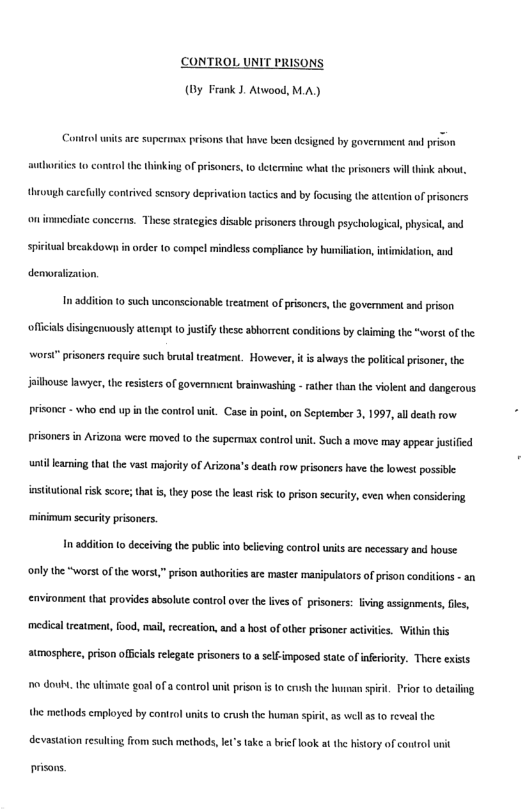
CONTROL UNIT PRISONS
By Frank J. Atwood, M.A)
Control wits are superma prisons that have becn designed by govermment and prison
auboriis o ot
g ofprisances, o detennine what the prisoners will
about,
thiough carfully contrived sensory deprivation tactics and by focusig the attention of prisoners
o immedine conce
. These statcgis disabe prisoners though pychalogical,physical,and
il brcakdow i onder 10 compel mindiss complianc by buiation, nmidaton, and
demorstzsion.
I addition t such unconscionable ratmen of prisoncrs,Uhe goverment and prison
official disingerusously attempt (0 justfy these abborrent conditions by chiming the “worst of the
worst" prisoners require such brutal ratment. However, it s lways the polticalprsoner, the
Jnilhouse aveyer, the esistess of govermmient bainwvashing - rather than the violet and dangerous
prisonc - who end up in the control unit. Case in point, on September 3, 1997, all death row
prisoners in Arizona were moved 1o the superma control uit. Such a move may appear justified
unillearming tht the vast majority of Arizona’s death row prisoners have the lowest possibe
institutional risk sco
s hat i, they pose the leat risk to prison security, cven when considering
i scurt pisoners.
1 addition to deceivin the public o beleving contrl s ar necessay and bouse
only the “worst o the worst” rison auhoresare mste maripulatorsofpison condions - an
environmen it providessbsot cotrlove th ives of prisones: ing asigments, s,
mecical rcatoen, food, il ecreation,and ost of oter prsoner activies. Wil s
amosphere, prison ofials relegte prsoners o8 sefimposed state of nferiorty. Thee exists
o douh,the
e goal of acontrol it prison is to crshthe s st Prior o detaling
the methods employed by control units (0 crush the human sprt, 0 well a5 f0 revel the
devastation resultng from such methods, e’ take brcf ook at the istory of control unit
prisons
Uistory
“The concept of using isolation and sensary deprivat
i prisons - the main tool used by
moden day conrol urits - began n the 1820's with the Tsten Stte Penitentiay in Phiadelph
Pennsyvaia (olso known s the “Pennsylvania Model” priso). The prevailing bt the
1620's ws ha soltary confnenent woukd e 10 reorse and ehabiltation, o hrougs
islation andsersory deprivation. Howeve, it soombecame videntthat salary confioemert,
slation,and seorydeprivtion caused mentalbreskdow and sy i prsoers.
Soon afler the establishment of the “Pennsyhvania Model" prison, i the 1830's, Charks
Darvin wasgiven tour and observed that te eisoners semed “dead 1o everthing ot the
foruingsnwety and o despal.” Subscquenty,inthe 1840, Chales Dickenstowrd the
Easter State Penitentiary and remarked that, “I bokd
slow and daly tampering with the
‘myseriesofthe brain 10 b immeasurably worse than any physical trture ofthe body.”
Furthermore, German fterature between 1854-1909 reveals that reslts of soltary confinement
included hallocinations (visual, auditory, tactile, and olfctory in nature), disassocation. hyseria,
agitation, motor excitement with aimess vilence, persecutory delusios, and psychosis (sce: .
‘Ganser, Atch Psychiste Nerver 1898). Finally, in 1890 the U.S. Supreme Court uled that
sensory deprivation and solitary confinerent caused violent insaity and condemned the practic.
‘Therefore, iolaton prisons were harshly criicized throughout the 1800
. 353 consequence of
causing rampant menta s in prsoners, and in 1913 solitary confinement was officially
abolished.
“The story does not end there. In 1962 a professor of psychology at the Massachusetts
Institute o Technology (MIT), Edgar Schein, suggested that physical, psychologial, and
chemical techniques could be used on prisoners (0 delberately alter behavior and attitude. Schein
a5 world renowned expert on psychologicalcoercian, having done extensive sudies of orture
‘and braiaashing techniques uscd on American prisoners of war, duriog the Korcan War, by
North Korcans and the Chincse. Scheinalso proposed isolaton, sensory deprivation, o desiroy
socialzation amng prisoners as well 1 to sever the
1k prisoners had to the outside world
y
Decause hunans valdat ther existence, hei personality, augh contact with others, solation
has sgaificant impact o the human psyche. This fo
o psychologicl disorietation, the
removalof othersfor validation of elf, came 10 be known as the “Muttnik Principle” (s0 named
by psychologist Nathaniel Braden) and was also calked the “Psychology of Invisibil
Buiking on Schein's lead, other psychologist suggested sing psychotropic medicaton to
menally, raber than physically, solate prisoners. University of Michigan psychologis James V.
McComnellfollowed up on this suggestion with an artice enied Criinals can be Briowashed
(Psyclology Toda
Apeil 1970). Then Havard psychologst B.F. Skinner aubored book in
1971, Beyond Frcsdom and Dignit,in whih he iscussed manipuiain the i ik cly.
Coninsing long th same pat, former .5 Duseaof Prisons diector, Jans V.
Bt suggested hat the fderal prison sysem was the peect place or human
experimentation with brainwashing techriques. That suggestion led to federal prison psychologist
anin Groder transfering prison agitators, suspected nilants, uilhouse laveyers, and other
onvioket prisoners o remote prsons (o be housed i solary confinement, Ifprisoners became.
‘complant then priviles were granted, otherwise,the psychologial orture continued. These
tactics mirtored Schein's proposalof using sensory fecdback reduction o creae predictable
crucks inthe mentaldefense system of prisoners which could then be filld with government
propaganda. T fut, Jessca Mitford wrote un arice, ‘The Torture Cue: [ Some American
Prisons i s already 1984 (Harper's, August 1973), which detailed resuls ofalboratory
experiment that was designed 10 test th efcts ofsensory deprivation o the burman mind:
Sensory deprivation,as a behavior modifer, was the sbject ofan experiment in
‘which students were paid twenty dollars o live n tiny soltary cubickes with nothing o do.
The experiment was o Lat at Ieast six weeks, bt none of th students could last or more
than a few days. Many experienced vivid allcinstons ... whik in s conditon, the
students were ed propaganda messages. No matter how poorly the messages were
prescnted, or how illogical the messages sounded, the propaganda had a marked cffect on
the atitudes of al students - an efectthat asied for at least one year aftr thy came out
of the experiment.
s
“The fis ederal contol unit was in Marion, Hinois, and upencd in 1972. Maron was an
xperimental project,intended for developing 8 program 1o mently breuk pisoners. 1 was
totally locked down n 1983 and has remained on lock down ever sioce prisouers averuge 224
hrs. daly i thei cell.
‘Subscquent 1o Marion being opened, various stales across America bl control urit
prisons nd by the carly 1980°ssupermax sensory depeivtion prisons began (0 lourish. By 1996
these were over forty conirol uit prisons housing some 15,000 prisoners. Even th federal prison
System reenered the scene when opering anothe contro! unit prison (Administrative Maximum
ADX)in Florence, Colorado,in Novermber 1994, Prisoners in ADX ar given rine bours of
outside recreation weekly, thee hours, thee times a week, with one other prisoner. Additionaly
ADX has four stages: (1) isolation cels, (2) gtting out of the cel to mingle witha few other
prisoners, (3) going from th cell o recreation ushandenled, and (4 job and better food
Conditons in Arizona's supermax control unit are e worse. There will ever be co-
‘mingling with other prisoners, movement while unhandeuled, better oo, or a job. Recreation
oceurs three times a week but only in one hour periods and alone. That s, prisoners in Arizona's
‘Special Management Unit (SMU) ae focked up for 165 out of 168 hours, ver 98% of the time,
cach and every week.
Such i the history of sensory deprivation control unit prsors. We il pow tum 10
methods utlzed by control uits and the devastating consequences
Methods
Control urits
(empt 0 branwash and mealy bilate prisoners through systematic
‘programs of oppression such as isolation, physical sbuse, psychological torture, medical neglect,
‘and other siister forms of behavior modification. In the section on control uit prison history, we
eamed that many of the current soltary confinement tactcs developed from brainvashing
techniques used during the Korean War. There are also reports which confirm that rsinwashing
and torure taticsemployed by both the CIA and the KGB have been adopied for e in
America’s conrol units.
asofar s hese tactie, on of the most comprehensive overviews resides in Biderman's
‘Chast on Penal Cocton (reprinted in 1983 by Amoesty Inernational i the Regot on Tortuc).
e chart i broken nto eight sectons,with each secton having wo subsetions (one on Purpose
and one o Variani). These sections and subscetions will e presented hre along with an
dditional subsecion (SMU) which detis stategies used in Arizona's control i
Sectiont: Isolation
Purpose: To deprive prisoners of socil supportGom both tber prisoersandthe cutside
work, 1o obstrctthe abilty (0 ress, to develop an intense concern with ef, and o create
dependence on captors.
Variants: Use of solary confnement through slation,partial solation, o group.
solion.
SMU: Groupisolation occurs tough colctve punishnent, one prisoner acts up e al
prisoncrs are punishe o rules, affctng allpisoners, re alered. The ioltion of prisoners rom
outside sourcs occurs by mail tampering (censorship, delayed delvery, arbtarly eturning
Jeters 0 sender, and lost mai), weekly S min. moritored and recorded phone cals, non-contact
st hrough glass and wilhout a phone (bothprisoners an vistrs mast stand throughout cach
w0 hour weekly vis inorder 10 barely b bl to hear), and routiney harassing and theatening
visiors. Finally, soltion fom other prisoners ocurs whe prisoners ar locked incells for an
average of over 234 s day, never touching orbeing touched by aotber person (uess begin
beaten by prison guards), o aceess o scrvices (education, reliion, o vocaton), and forced
dencss.
Secionis Momapolasion o Perston
Purpse: To i aenion onone’simdae prediamet 0 cliiatc any sl
competing with st cotrlled by captors, a1 el actions o cosisent i
compiaee
Vst Taain,beight igh, barenemvronmen,restritd movrent,
[——
SMU: A i s slon, s eeding scton. lorescen igting rensioeon o 17%
s il which provides beght cvionmen cvn drig the igha“Gin” ght e on)
Bland o, no swee dessrts,small portons,and ddy sk nches contues monolonous
food. Restted movement it when prisners e badeufedbeindthe back and escored by
guand wheaever eaving thecell. iy, barencnvieonment s povided by he pece de
resstance afcontol s, sensory dpeivation. Thisincudes unpained walls s well 50 plant
o il e s i, su, sy, windows, o bbby cra. The s disussed previously
olton, frced lenes, nd o acces 10 sries -l ply a ol nproducin the baren
environment.
Section I Induced Debiltyand Exhaustion
Purpose: To weaken boththe physical and the mental abily Lo esist.
Variants: Sem-stavation induced llness and exploration of pre-cxising infury, slecp
depravation, and prolonged constait.
sMuU:
1 addition to morotonous food tactcs, semi-starvtion oceurs rom severe
retrctions on commissary puschases (only junk food and sweets, o wholesome foods offered),
inabifty o obtain adequate natition from prison meals, nd an extremely sedentary estyle. The
e to provide cold weather cothing during outdoor exercsein wintr or when feczing
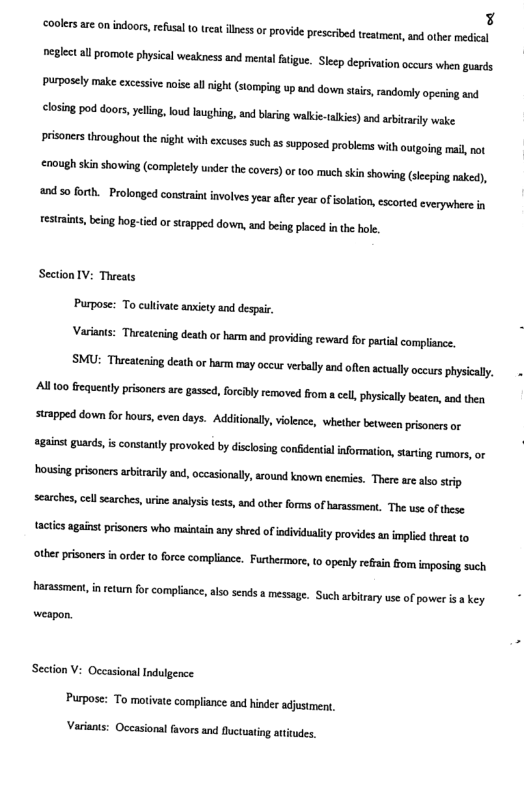
3
coolesar omindoors, refsal 0 e s o provideprescrbed tesmen, and other medical
closing pod doors, yeling, o lnughing, and baring wlkie-akcs) ad bty vake
prisonersthroughou the night withexcuses such as supposed problems with o,
oing mai,not
€7eUgh sinshowing (competlyunder the coers) o (o0 much kinshowing (slcpingraked),
20 forth. - Prolonged constant involves year afler year of solatio,esorted everywhere i
estraints, being hog-tid or srapped down, and being paced in the hole.
Section IV: Threats
Purpose: To cullivate anxiety snd despai,
Varants: Thicatering death or barm and proviing reward for partil compliance,
SMU: Thecatcing eath o barm mayoccur verblyand ofenatullyoces physicaly:
Alltoo fequently prisoners are gassed, forcby removed fom cell,physiclly beaten aod thea
suapped down for houss, even days. Additonal, vilence, whether beween prsoncrs o
gt guards, is constanty provoked by disclsing conidentialinformtion, staring ramors, or
housing prisones ariraily and, occasionaly,around known enics. There re sl srp
searches, cel searches, urine analysis tests, and otber forms of arassment. The use of these
tactis aganst prisoners who maintan any shred of individualityprovides an implied hreat 10
othe prisonersin rder o orce complance. Futhermere, o opnly refain fom nposing such
Porsssment, i retum for complance, abo sends messge. Such by we of poersakey -
weapon.
Section V: Occasional Indulgence.
Purpose: To motivate compliance and hinder adjustmen,
Varianis: Oceasional favors and fluctuating atitudes.
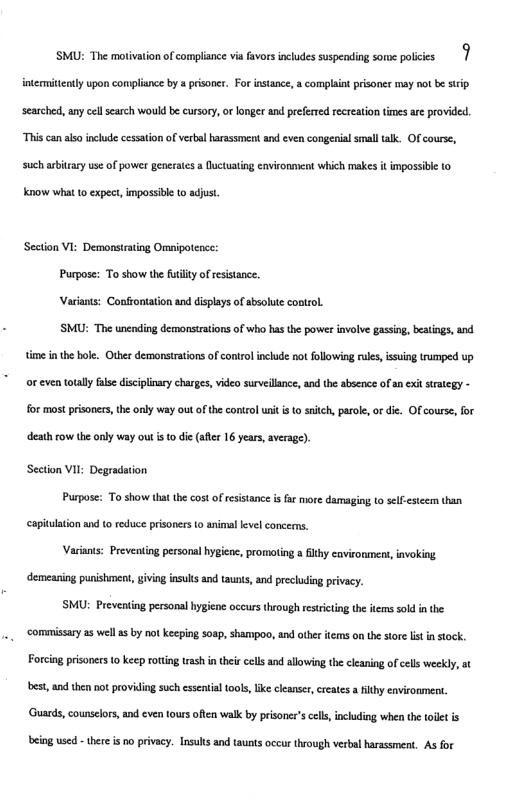
SMU: The motivation f complsnce via fivoes nchudes suspeoding some pobices |
intemitenly upon complisnc by prisonr. For istance, & complaint prisones may not be stip
seached,anycell search wouldbe cursory, orlonger and pefered rereaton ioesare provided.
“Thiscanasoinclade cesaton of verbl arasment and even congenial smaltalk. Ofcourse,
such iy use f power generats fuctuting cnvionment which makes i impossibe 10
Know what to expect,impossible to adjust
Secton VI Demonstrating Oripotenc:
Purpos: Toshow the Rty of rsstance.
Varints: Conffonaton nd displys of shsohse ontroL.
SMU: The unending demorstations of wh has e powes invlve gassin, beaings,and
e inhe bol. Otberdemonsirations of coniro include ot following e, s truped up
orcven otally s discipinay charges, videosureilance,an the absence f an e iriegy -
for most pisones he anly way ot of the ontrol it i 0 snich,prol, o die. Ofcourse, or
death row he anly vay out i 0 de (s 16 yeas, averag)
Secton Vl: Degradaion
Purpos: Toshow hat the cotofresstanc s o more damaging o seestecm than
captulton nd (o reduc prisners 0 animal vl concems.
Vadians: Preventing personal ygieos, promoing a ity cavironmen,ivoking.
demeaning punishonent, ving inuls and tunt, e preclding prvacy.
SMU: Preventing personal hygine occurs though esitng the s sold i he
commisary 5 well 5 by ot keeping soap, shampoo, and e ems o he sor st i sock.
Forcing prisoee 0 keep oting s i thei cls and allowing thecleaing of s weekly, t
‘best, and then not providing such essential tools, like cleanser, creates a filthy environment.
uards,counslors, nd ven ours oft valk by pisoner'scl,ncding when the et is
being used - there i no privacy. Insuls and taunts occur through verbal harassment. As for
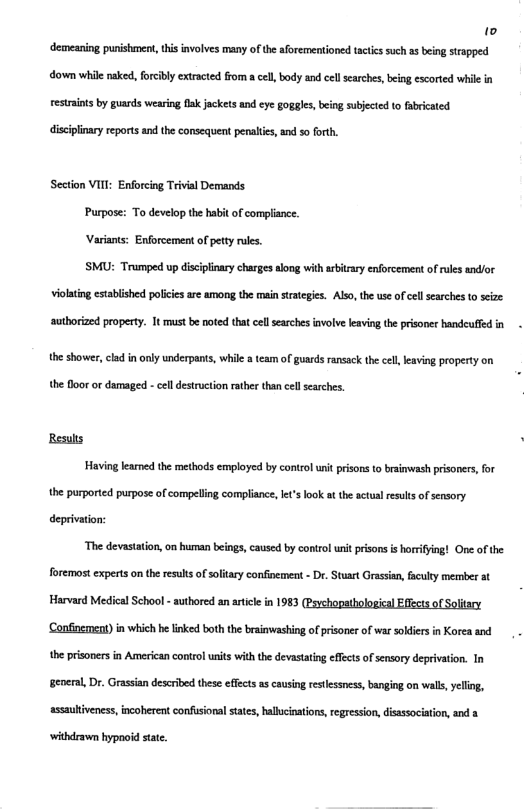
w0
demeaning purishiment, this involves many of the aforementioned tactics such ss being strapped
dowm while raked, forcibly extracted from a cel,body and cel searches, being escorted while in
restrants by guards wearing flak jackets and eye goggles, being subjectd to fbricated
discplinaryreports and the consequent penale, nd 5o foth.
Section VIII: Enforcing Trivial Demands
Purpose: To develop the habit of compliance.
Variants: Enforcement of petty rus.
SMU: Trumped up discplinary charges slong withsrbitrary enforcement of rules and/or
violating established policiesare among the main stategie. Alo,the use of cellsearches to seize
‘authorized property. 1t must be noted tha cel searches involve leaving th prisoner handeuffed in <
the shower,clad in only underpants, whik a team of guards ransack the cell,kaving property on
the loor or darmaged - cell destruction rather than celsearches
Resuls .
Having learmed the methods employed by control it prison to brainweash prisoners,for
the purported purpose of compeling compliance, let's look at the actua reuls of sensory.
deprivaion:
‘The devastation, on human beings, caused by control unit prisons is horifying! One of the
foremost experts on the resuts of sofitary confinement - Dr. Stuart Grassin, aculty mermbes at
Harvard Medical School - authored an artcle in 1983 (Psychopathological Effcts of Soltary
‘Confinemeny) in which he inked both the brainwasking of prisoner of war sldirs in Korea and
the prisoners in American control units withthe devastating effcts of sensory deprivation. In
general, Dr. Grassian described these effects as causing restlessness, banging on vll,yelling,
assauliveness, incoherent confusional state, hallucinations, regresson, disassociation, and a.
ithdrav hypnoid sate.
n
As pat of hisresearch fo the aticl. Dr. Grassian studied fourteen prisoners who had
been i soltary conlinement for an average of two months a the prison in Walpole,
Massachusets, When reporting the results of tis paticula stdy, in the same 1983 artice, Dr.
Grassan il poioted o th intnse effot by each prisoner 0 minimizs the effctsof solation.
However, aftr diigent digging, Dr. Grasian found that th (ollowing symptoms were common
resls:
Cutting and sel-mutltion, fea ofinsanity, hypersensitiviy to extenal stmul (.,
lighting becoming very uncomfortable, smels appearing o be quit sron, noises causing much
iritaion), perceptual distorions and lusions, hallcinatios, derealization, massive free-floating
anetes(lading to panic, ear, and diffculy in breathing), scute confusional sttes, partal
‘amnesia, iffeulty with concentration and memory, disassociation, disorientation, fatasy of
aggressive revenge (torture and mutlation aganst guards), persecutory fear, suspiciousness,
paranoi, random violence, andlack of impulse control.
As an expert withess in the mid-1990's civil lawsuit case Madrid v. Gomsz, Dr. Grassian
‘conducted another study involving prisoners i solation. This stdy included ity prisoners in the
control it in Plican Bay, California. At the conchusion of this stdy, Dr. Grassian discovered
that foty ofthe iy prisoners (80%) had either massively exacerbated a previous psychiatric
illessor had developed psychiatrc symptoms associated with reduced environmental stimulation
(RES) a5 result of soiary confinement. RES is a psychiaric condtion charscteized by
‘perceptualdistorton, hallucinations, hypersensitivity to extemal stimuli, aggressive fantasics,
‘paranoia, inabilty to concentrate, nd poot impulse control.
Insofar asresuls of sliary confineocat, a report by the American Journal of Psychiatry
confrmed that sensory deprivation eads 1o hallucinations, aniety attecks, probiems with impulse
control, and self-mtiation. Addionally, as a consequence of personal experience with sensory
deprivation in control uni prisons,the author of this paper has also experienced depression,
delusion, headaches, bypertension, hypersensitiviy, and anti-social behavior and atitude. Fially,
i regands o effcts of sofitary confinement, currt fiterature (Dr. Grassian, et al.) report that
sensory deprivation actually altrs the chernical balance i the besin and undoubledly canses
significant persoraliy changes.
‘Consequently, b reviewing this author’s personal experience, Dr. Grassan's studis, and
reports by the American Journal of Psyehi. 1, we can see that nothing has changed since solary
‘confinement was known 1o cause enta liness and insaiy in the 1800's. Current studies and
reports are virtually enical o th reports from Germany between 1854-1909 (remember, the
German iteraure repored psychosis, hystria, hallucination, agtaton, motor excitement,
disassociation, random violence, and delusions s resuls of confinement in isolaton).
Conchusion
“Thi i has cearly demonsrated tha th use of control urit prisons causes menal
breakdown n prisooers. In and of e, such devastatig reulsare most tragic, howerer, even
more bomifing is government's fll knowiedge of the destrction they ar causing o humans. Tn
the mid-1990's Dr. Grassian disclosd the resuls of hiscomprehensive stuics, involving the. iy
control it prisonrs at Plican Bay, o both ederal and sae governments. Ratber than take:
cometiveacton, o mmediatly ceas th, commision ofsuch atrocites agains human beings,
th federal government enacted the Prison Litigation Reform Act (PLRA) n 1996. The PLRA
efictively preciudes prisoners fom suing for “emotionalor menlal harm unless they can also
prove physcalinjury.” That' right, the govermment enacte the PLRA o specfally exclode
awsuit, o flly absolve both government and prisons rom ay iabily, which resuls fom the
Koowing and intenionsl psychologicaltorur, peformed in control unit prisons, and the
devastting consequences. God belp us all.
“The author of his article i on desth row in Arizona. For additional information on control usits,
o to make comments and ask questions, please contact
Frank J. Atwood K287 So.Ct ABC Zine Distro
Arizona State Prison PO Box 721
Box 3400 - SMUII (Death Row) Homewood. IL 60430
Florence, AZ 85232